
My Vermont

A few weeks before my Uncle Breck died, my 93-year-old father and I took Amtrack’s Vermonter from Washington D.C. to White River Junction. It was a pilgrimage; a trip made with the understanding that it might be the last time we saw my father’s younger brother. I packed sandwiches, a sack of mandarin oranges, and two large thermoses of coffee. Daylight was just breaking as we set out from the station, the porters in their bright red caps like cardinals across the tracks. Lost in thought, we sat across from one another on opposite sides of an aisle, unsure of what we would find when we arrived. I remember how the train rocked us across each of the eight state lines, her whistle blowing with decorum, as if to mark the somber nature of our journey.
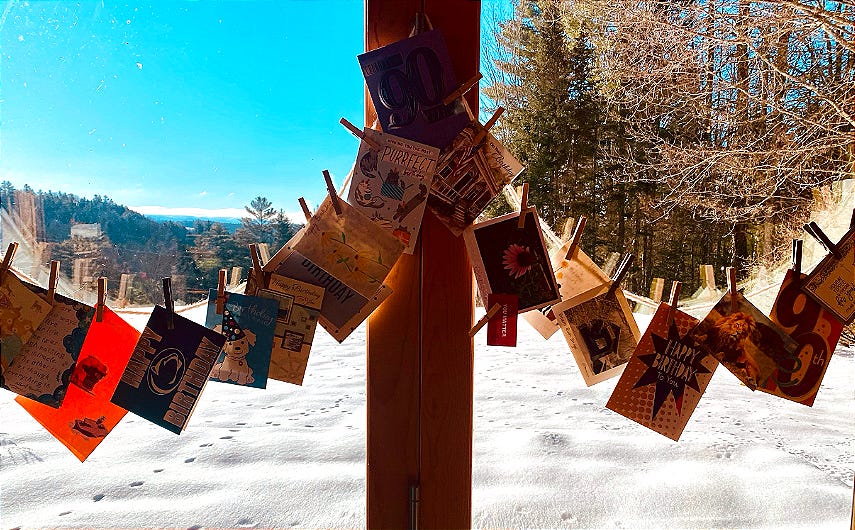
It was mid-February. Outside, there was snow and ice. Inside, my uncle was surrounded by wood that glowed of gold and amber, by the rising heat from the kitchen’s old wood stove and the string of colorful birthday cards for his 90th birthday that still hung in a garland against the back window of my cousin’s house.
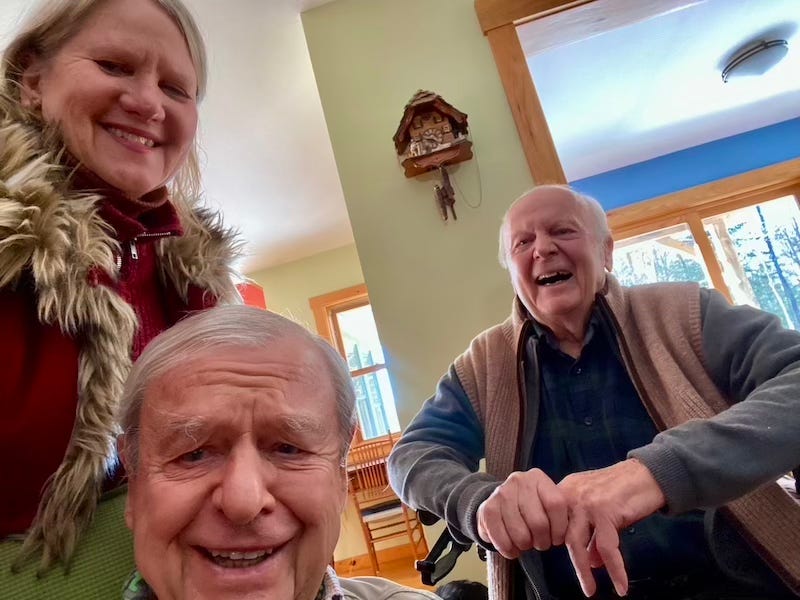
For three days and nights, we ate and drank. We laughed. We took silly photographs. My father insisted on driving my cousin’s car, using a gearshift for the first time in years, as we careened around hairpin turns, spinning on the ice. We behaved as if there was no such thing as death and when we turned to leave, we smiled and waved, put on our bravest face as the front door closed behind us.
As the weeks passed and Breck was confined to bed, that trip became my touchstone. The train journey with its many stops, with its resounding whistle and strips of blue fog that covered the mountain ranges; Appalachians, Berkshires, the White Mountains and Green Mountains. All of it together became a means to travel back in time, to string my own necklace of Breck’s life and our years together.
I remember one summer, many years ago, I watched as Breck helped his daughter Diana over a large boulder into the local waterhole where all my Vermont cousins went to swim. Diana was born with cerebral palsy and struggled with mobility. The day was hot and the water icy. There were loud cries of pleasure. I recall Breck poised by the dark and slippery rocks, his eyes trained on Diana, his long fingers cupped like a mitt, ready to catch her if she fell.
During the summers we spent in the U.S. when my mother wanted to rent a summer house in a Vermont town called Eden, Breck always met us with a Cherokee jeep. Where that jeep came from, I don’t know, but it seems to me he taught my non-driving mother to drive, sitting beside her with all of us children in the back seat as she pressed down hard on the accelerator, lurching ahead, while Breck sat patiently, hands folded on his lap, prepared to take the wheel should something happen.
Perhaps it was this feeling that I searched for and that Breck so readily provided. A feeling that, no-matter what, he could be relied on. No-matter what, I could go to him, speak with him, confide in him. Dressed in his summer uniform of short sleeve shirts and sensible shoes, Breck was my Vermont. He was synonymous with the sweep of birch and maple, with the lilac bushes and lily of the valley, with the cold black lakes and soft mud bottoms that we all referred to as “home” whenever anyone asked. Over the many years that my mother and sisters and I traveled back and forth to Northern Vermont from India and Romania, from Tanzania, Israel and Jordan, Breck went to look at rental houses on our behalf.
“Too far back,” he advised. “No screened porch,” he said, leaving it at that. He gave us directions along those country roads--so foreign to us--always leading the way. And we followed, tracking land that was once home to the Abenaki Indians, he said, the tribe of Native Americans who were forced to flee when the Europeans arrived.
I tried to remember when we began talking about books together. Was there a moment when our relationship changed?
Maybe it was when I went to a writers’ residency and became friends with a New York painter who knew Breck from St. Johnsbury. Once, the three of us met, and shared conversation about our work and our lives. Breck took such pleasure in these exchanges, in the descriptions of the way light moved across the sky. About the Hudson River School of painters and their belief that nature was a manifestation of the divine, that land was blessed, and that art might lead to spiritual renewal.
Or maybe it was when my grandmother died and I went to see him in his studio apartment above the Dana Company, in the small town where he still worked, making livestock supplies, ear tags and tattoo markers for cattle. By then, three of his family members had passed: his daughter Diana, his ex-wife and now, his mother.
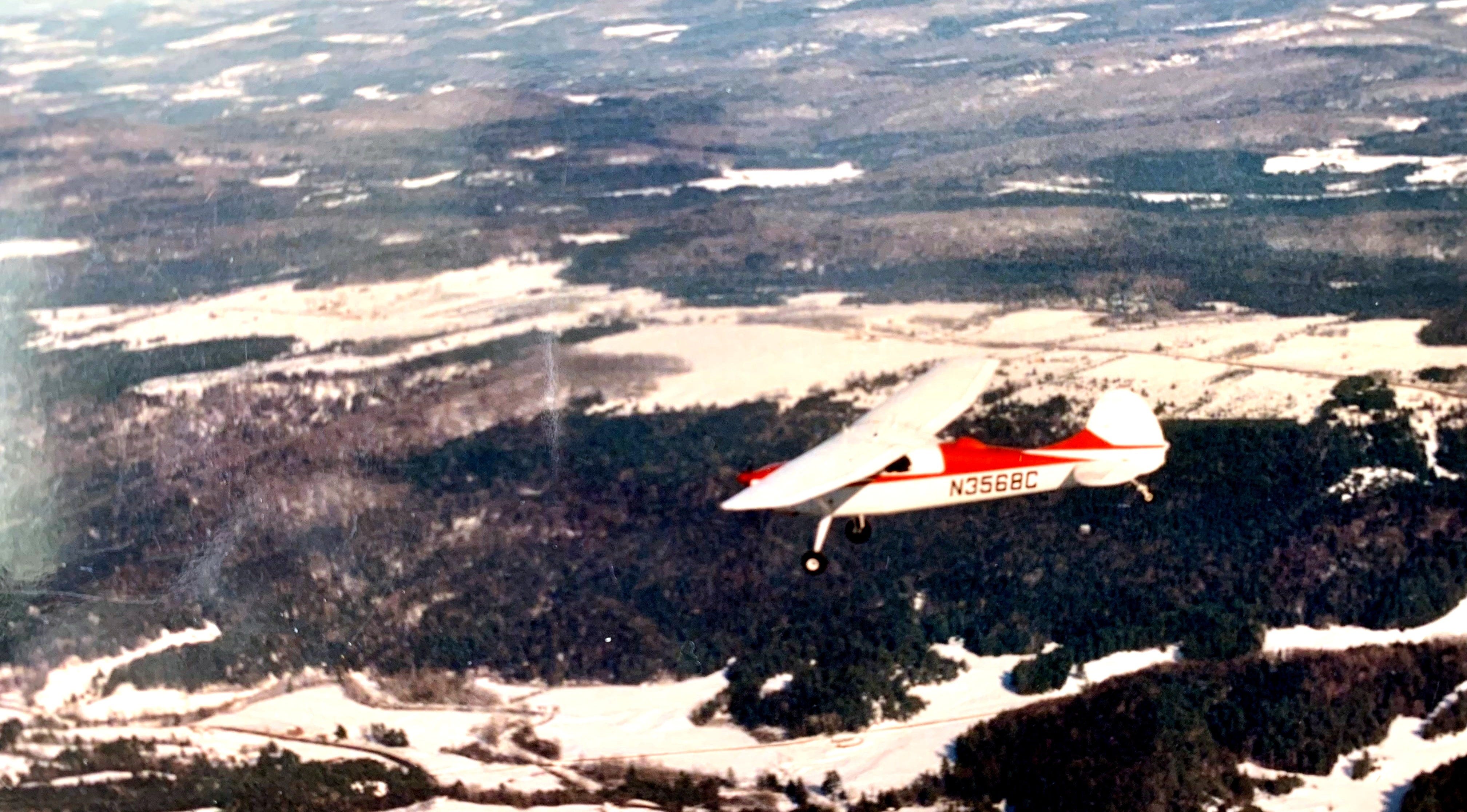
We sat quietly that day, he in an armchair, saying little. I remember the same pale green color of celadon that I always associate with Breck. Perhaps it was his camouflage, the color of a man who does not want to draw attention to himself. A man who flew his Cessna 170 for more than two decades. N3568 Charlie, he repeated into his radio piece, his voice soft and low, as he mapped the land beneath him, flying over valleys and mountains, streams and rivers, translating life from the air.
We both loved James Salter and I had recently read, Solo Faces. Maybe it was then, trying to change course, the sadness between us, that prompted us to speak about the novel and Salter’s life in the air force, how he flew for 12 years in the Pacific and the magic of his short sentences. I recalled the quote from Salter, who wrote, “Life passes into pages if it passes into anything.”
When Breck sent me his short story, You Mountains, about a young man living in Montana who falls in love with Georgia Bird, a woman from the Native Cree Tribe, we began another kind of exchange. We wrote back and forth. There was a new language between us. A different level of trust. Together, we examined his protagonist, the nineteen-year-old who was in love with the West, the man who sought adventure and living close to the edge. A man whose Montana defined the shape of his life.
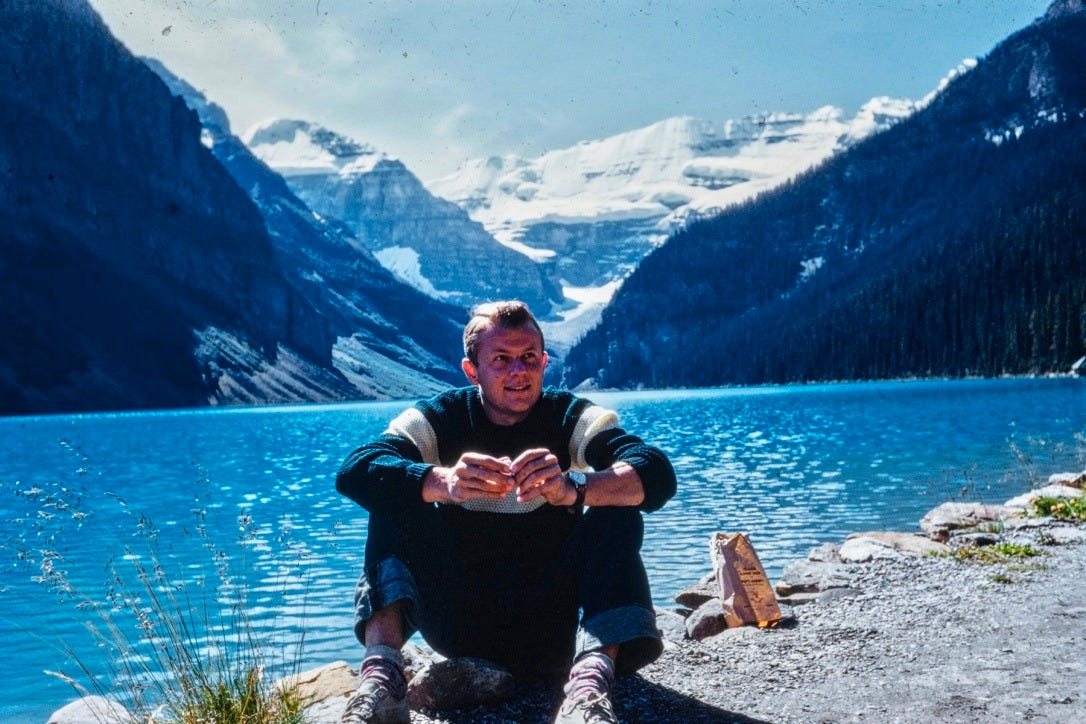
(from Breck’s story)
We hunt for what we don’t raise –and we plant an enormous garden. We ranch on 6,500 acres. It is a hard way to make a living, ranching, but animals and mountains and a bountiful valley with a snow-pack, clean river instill in all of us a deep love of the land. That love is still there although everything has changed now.
The day before Breck died, I was in New York, staying in a friend’s apartment. We spoke on the phone and although his breath was labored, his voice almost a whisper, I thought I heard him laugh as I relayed the story of teaching poetry in a community where my sister Lulu, with Down syndrome, still lives.
“They were all fired up,”” I said, describing the group of Lulu’s women cohorts who turned rebel after a class on Maya Angelou. “Phenomenal. Phenomenal Woman,” they chanted. “Phenomenal!” They shouted.
“I love you,” I said, waiting for him to muster breath. “I love you,” he said. And in between the silence that was between us, appeared that same shade of celadon green, shimmering now, slowly becoming the rivers and valleys of his life, land that he was an inextricable--and unchanging part of--- and then there was the man whose hands, even in the last moments of life were held out to me.
Such a beautiful story, Alex. I could feel you and your Uncle Breck and the Vermont landscape in each sentence. You have captured so well how the landscape and the person who lives in the land become one. Such a beautifully painted and felt landscape portrait with your words. Thank you so very much!
You would not imagine how much your family stories -more than any others- make me feel as if I’ve been there…Thank you Alex